
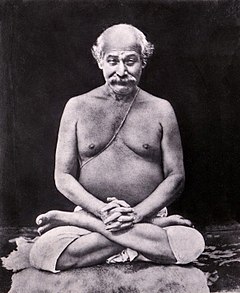
Lahiri Mahasaya, one of the greatest yogis of modern India, was born on September 30, 1828, in the small village of Ghurni, Nadia district, Bengal (present-day West Bengal). His full name was Shyama Charan Lahiri. The name “Lahiri Mahasaya” — meaning “the great-souled Lahiri” — was lovingly given to him by his disciples in later years.
He was born into a devout Brahmin family deeply rooted in the worship of Lord Shiva. From his very birth, there were signs of a soul destined for greatness. It is said that as an infant, he was often found sitting in a natural meditative posture — a remarkable sight that left elders around him quietly in awe.
Early Loss and Simplicity
Lahiri Mahasaya’s early childhood was touched by sorrow. When he was just three years old, his family’s home was submerged in the floods of the Ganges river, and the family was forced to relocate. Tragically, his mother passed away when he was very young, leaving a quiet void in his childhood. Yet despite this loss, young Shyama Charan grew up with an unusually calm and composed nature — unattached, thoughtful, and deeply drawn to solitude and prayer.
His father, Gaur Mohan Lahiri, was a sincere devotee of Lord Shiva, and this devotion deeply influenced young Shyama Charan. From childhood, he would sit for long hours near Shiva temples, sometimes found covered in mud and sand — naturally and playfully creating Shivalingas, as if his soul already knew its path.
Education and Sharp Intellect
The family eventually settled in Varanasi (Kashi) — the eternal city on the banks of the Ganges — which would become the home of Lahiri Mahasaya for most of his life. In Varanasi, he received a solid education and showed remarkable intelligence. He mastered Sanskrit, Hindi, Bengali, Urdu and Persian — a rare achievement that reflected both his sharp intellect and his broad spiritual curiosity.
He was known among his classmates and teachers as a boy of exceptional character — honest, humble, and unusually mature for his age. He never displayed arrogance despite his brilliance, and his calm demeanor made him naturally respected by all who knew him.
A Householder from the Beginning
Unlike many saints who renounced the world from youth, Lahiri Mahasaya’s path was different and unique. He embraced the life of a householder (grihastha) — a path that would later become central to his teachings. He married Srimati Kashi Moni Devi and lived the life of an ordinary man — working, raising a family, and fulfilling all worldly duties.
This was not an accident. His entire life was a living message that spiritual liberation is not reserved for monks and renunciants alone — that even a common man, living in the world, working and loving his family, can attain the highest states of consciousness through sincere practice.
His life in these early years laid the quiet, unassuming foundation for what was to come — a divine encounter in the mountains of Ranikhet that would change not just his life, but the entire course of yoga in the modern world.