
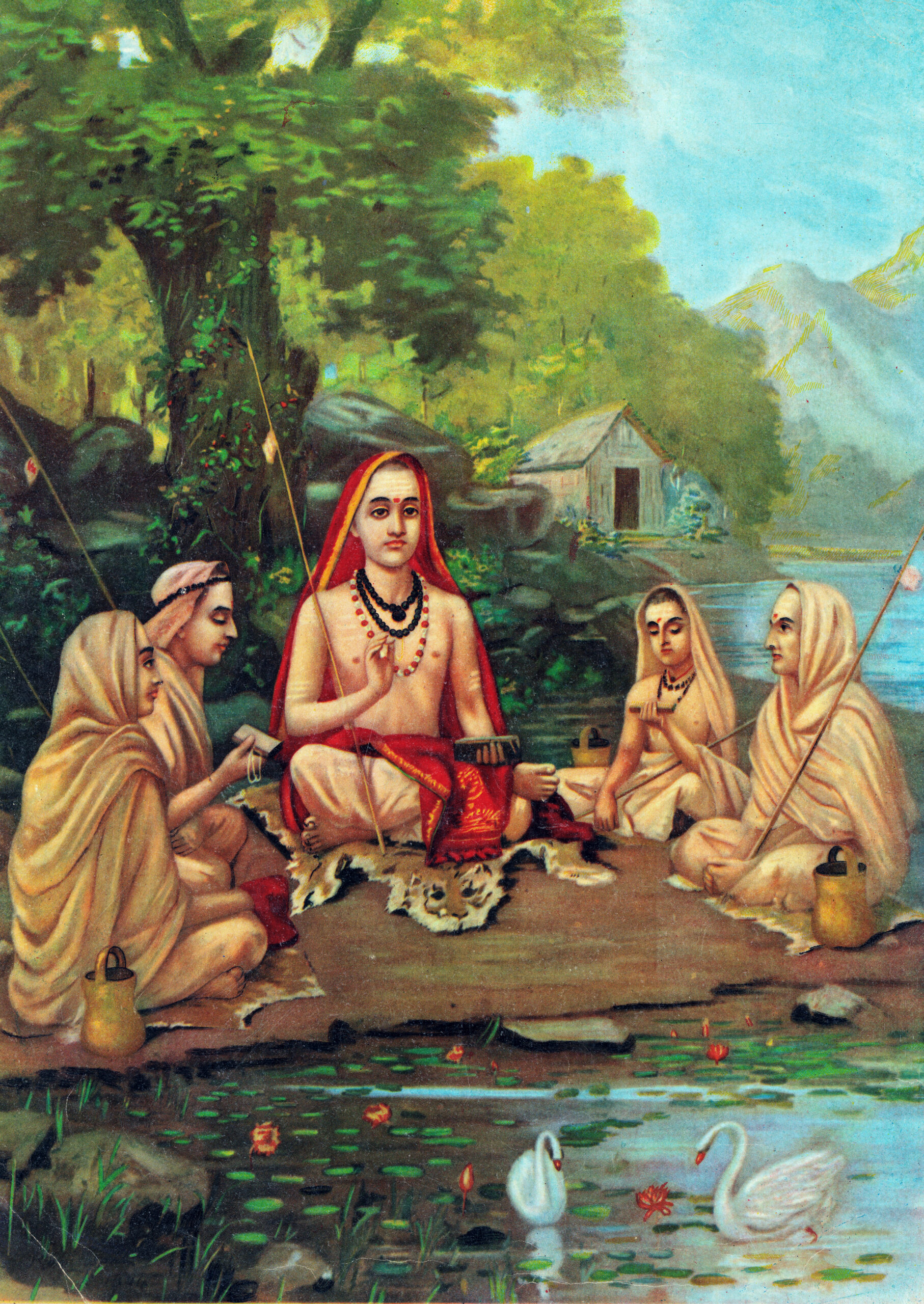
Adi Shankaracharya, one of the most luminous spiritual giants in Indian history, was born in Kerala around the second century B.C. His arrival on the spiritual scene of India came at a time when the ancient Vedic monastic tradition had lost its organizational strength. What he built in his short lifetime continues to shape Hindu philosophy and monasticism to this very day.
The Context — A Spiritual India Before Shankara
Long before Shankaracharya walked the earth, India was home to three major monastic traditions — Vedic, Buddhist and Jain. The Buddhist tradition received its greatest boost from Emperor Ashoka, the grandson of Chandragupta Maurya, who had married Helena, the sister of a Greek commander-in-chief. This unique heritage made Ashoka a man of extraordinary intellect — a blend of Greek and Indian blood.
Ashoka was a brilliant but ruthless conqueror. His conquest of Orissa, where millions perished, shook him to his core and transformed him into a devout Buddhist. Under his patronage, Buddhism spread systematically across India, Sri Lanka, Tibet, China, Japan, Thailand, Indonesia, Vietnam, Afghanistan, Iran and many other nations — creating one of history’s most remarkable spiritual expansions.
Shankara’s Mission — Reorganizing the Vedic Tradition
When Shankaracharya arrived, he found the Vedic monastic tradition in disarray. With extraordinary vision and energy, he founded the Dasnami Sannyasin tradition — a beautifully organized system of monks classified according to their life situation and learning. Those dwelling in the hills were called Parvatam. Those at pilgrimage sites were called Teertham. Monks in great cities like Kanchipuram, Ujjain, Haridwar and Rameshwaram carried the title Puri. The scripturally learned were called Bharati, while those of exceptional brilliance bore the name Saraswati. Other orders include Giri, Sagar, Vanam, Aranyam and Ashramam — each name reflecting the monk’s circumstances and calling.
To anchor this tradition geographically, Shankara established four great Mathas (monastic centers) across India’s four directions — Joshi Math near Badrinath in the north, Puri Math near Jagannath in the east, Dwaraka Math in the west, and Shringeri Math near Mysore in the south.
The Heart of His Teaching — Advaita Vedanta
Shankaracharya gave these monks one sacred mission — to teach the oneness of all life and reality. This is the essence of Vedanta, specifically Advaita Vedanta — the philosophy of non-duality.
His teaching, rooted firmly in the Vedas and Upanishads, declares that the entire universe — seen and unseen, manifest and unmanifest — is fundamentally One. Not two. Not many. One absolute reality.
He expressed this beautifully in the immortal Sanskrit verse:
“Brahma Satyam Jagat Mithya, Jivo Brahma Naiva Na Aparah”
Meaning — Brahman (the Absolute) alone is real; the world is an illusion; and the individual soul is none other than Brahman itself.
This profound vision places Vedanta alongside the monotheistic cores of Christianity, Islam and Sufi mysticism — all pointing toward the same singular truth, expressed through different languages and traditions.
The Sannyasin’s Sacred Boundary
Shankaracharya’s monastic system carried one firm rule — monks must never enter politics. Their singular focus must remain on spiritual realization, teaching, and guiding seekers toward the Self. A sannyasin’s life is devoted to learning Sanskrit, philosophy, science and history — but never political ambition.
This boundary keeps the tradition pure and trustworthy across centuries and generations.
The Search for the Soul — His Eternal Message
Perhaps Shankara’s most urgent message for modern humanity is this — man has lost his soul.
We are fully aware of our bodies, our emotions, our anger and our desires. But are we aware of the Self within? Do we feel that silent, unchanging presence beneath all our thoughts and feelings?
Shankaracharya’s entire life and teaching was a call to return to that Self — to stop identifying with the temporary and awaken to the eternal. This is the purpose of human life according to Vedanta, and this is the duty that every Dasnami sannyasin carries forward to this day.
On this sacred Shankaracharya Jayanti, Likhitham salutes the timeless wisdom of Adi Shankaracharya — whose light continues to illuminate the path of countless seekers across the world. 🙏